 >
>
Pat’s Wildways: Ants and Naked Mole Rats




For the past couple of years now I’ve been revisiting Portal, Arizona again and again, and each time is different. This place in the far southeastern corner of the state borders the Chiricahua Mountains at the edge of Mexico and New Mexico, and remains a wild land for both wildlife and people. Because the American Museum of Natural History has its Southwestern Research Station there, many wildlife biologists have been temporarily based there to do their studies, and many have since decided that this is a great place to put down roots. It is said that Portal has the highest percentage of Ph.D.s in Arizona, and whether this is true or not, I fit right in.
Many of these settlers are biologists, like myself, and many have brought their unique fields of expertise to the area. Each time I visit my connections there expand — I am always on the lookout for new people and information to learn from them.
This time I sought out Ray Mendez, an expert on “eusocial” animals, a retired zoo exhibit designer, the handler of the moths in the film "Silence of the Lambs," a conservationist with decades devoted to helping Trinidad and a generally interesting fellow who has lived in Portal with his wife Joy for decades. What brought him to my attention was his colony of naked mole rats. You may not have heard of these, but as a zoologist, I have. These small hairless rodents from South Africa spend most of their lives underground in colonies that resemble those of some bees and ants and other insects. There is a queen, a few fertile males and a number of specialized non-reproductive workers of a few generations that keep their “hive” clean and orderly. Researchers studying these animals have found other interesting facts about them. Unlike most mammals, they are “cold-blooded” with their body temperature regulated by their environment; they have no pain sensors in their skin, and they are very long-lived and resistant to cancer. Ray is one of the first to design zoo exhibits for these odd animals and now keeps a colony safely enclosed in an indoor habitat constructed of various chambers with food, bedding material and room to spread out. Once I heard about Ray’s colony, I just had to see them.
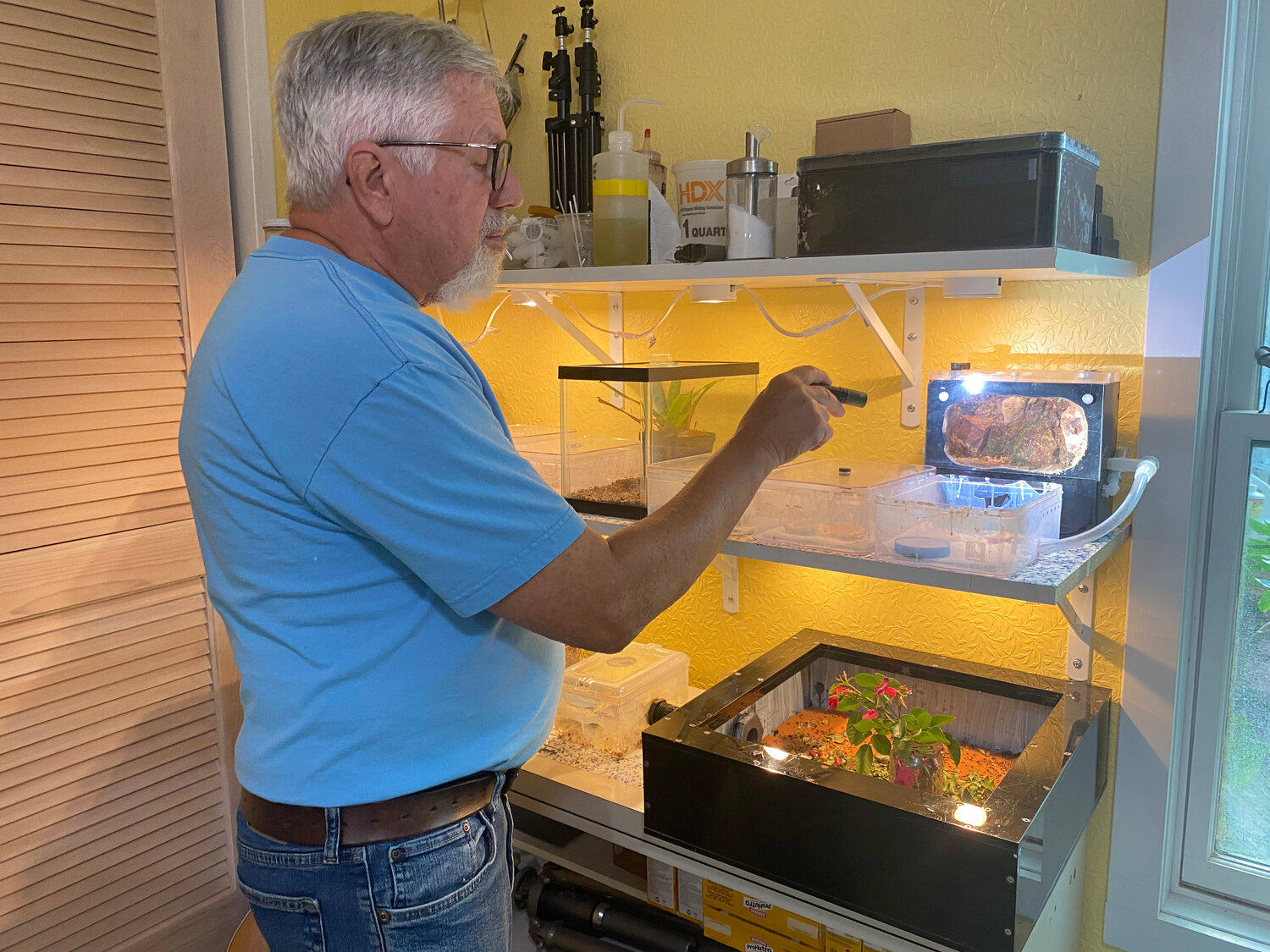
When I called Ray and introduced myself, he generously invited Bucko and me to his home to see this colony. Their home is high on a private dirt road overlooking the Cave Creek Canyon, a beautiful setting if there ever was one. One inside their mountaintop fortress, I oohed and ahed about the small, ugly, hairless rodents, and then noticed the rest of the enclosures in his office. Good heavens, he had a number of interesting native eusocial ant colonies set up, too. It didn’t take much urging for Ray to show off his collection. And Bucko and I were fascinated.
His ants, like the naked mole rats, are eusocial, with colony members performing very distinct separate tasks. Ray’s formicaria (ant farms) are constructed so that different layers of the nest can be examined separately. When he opened up a nesting chamber all of the inner workings of these civilizations were revealed.
Bucko and I marveled at the Apache twig ants, a stinging species, but fascinating to see the dark male with wings ready to fly off amid a sea of ant larvae. Since Ray’s ants are all native species, they can be safely released to the wild. In a nearby formicarium, leaf-cutter ants were rapidly dismantling a flower and carrying petals back to another chamber. And most interesting of all, to me at least, were the honeypot ants with their specialized workers called “repletes” that turn into a food storage receptacle for the rest of the colony. These ants have large expanded abdomens full of a honey-like sweet mixture that the rest of the workers feed it until it enlarges. Then, when the regular workers are running out of other food sources, they merely need to tap on the replete with their antennae, and it disgorges some of its stored larder to feed them. Amazing.
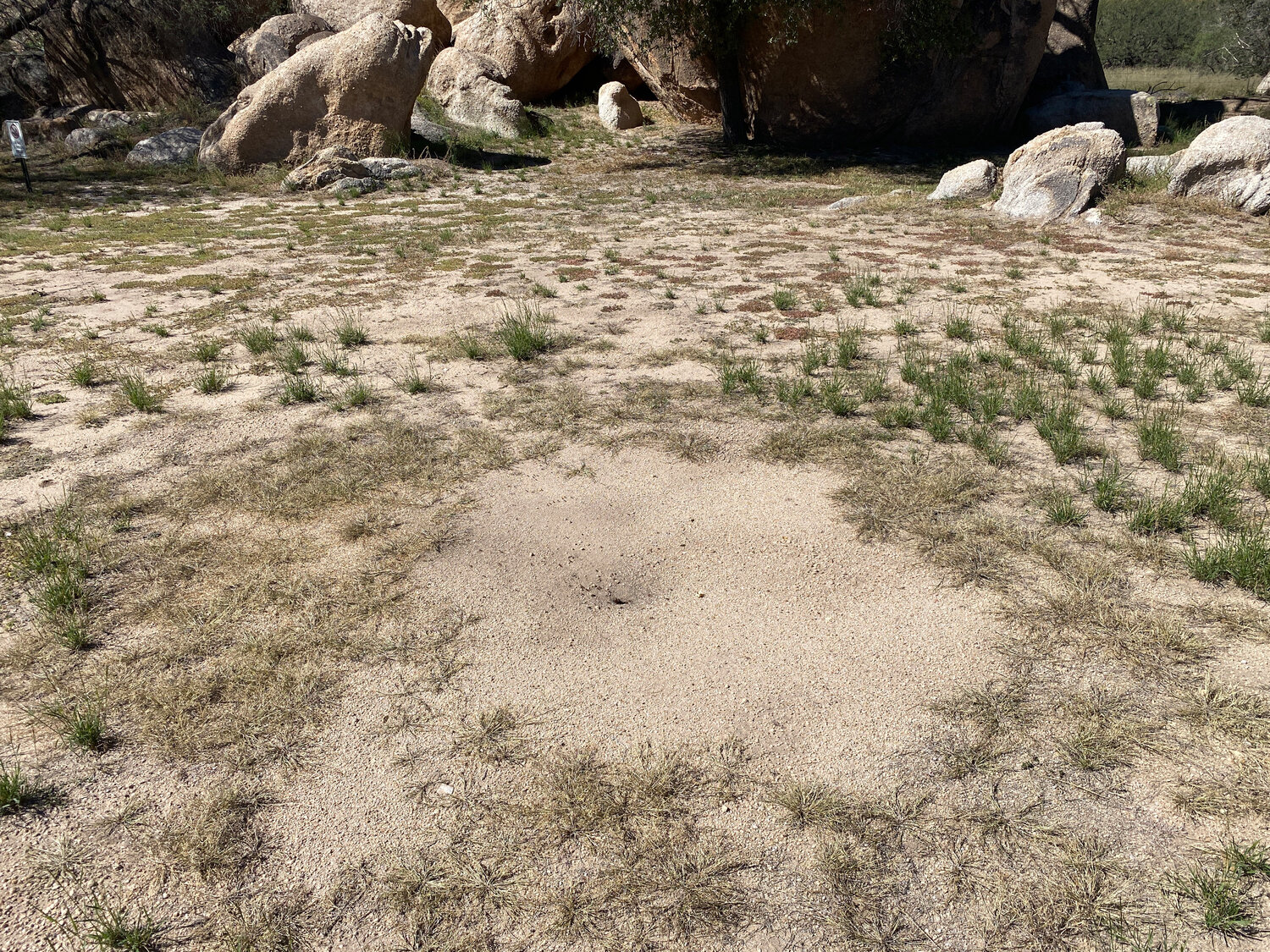
For the rest of our Arizona trip I was fascinated by ants. Wherever we walked, I now noticed anthills that I mostly would have previously ignored. And with my brief views of inside ant nests at Ray’s house, I started to wonder what ants they were and what activity was happening underground out of view.
Thanks to Ray for opening up this whole new world for me. I just never know what new information I will bring home from my visits to Portal, Arizona. I can’t wait to return!
Pat Foster-Turley, Ph.D., is a zoologist on Amelia Island. She welcomes your nature questions and observations. patandbucko@yahoo.com


Comments
1 comment on this item Please log in to comment by clicking here
LucyP74
I always enjoy reading your fascinating articles, Ms. Pat. Our native moles and voles are interesting little creatures that I would love to learn more about. Their abnormally large “hands” are quite cute! (I can’t recall if it is the moles or voles that have those.). Thanks for sharing your adventures!
Friday, December 26, 2025 Report this