 >
From Spanish settlers to Black Civil War soldiers: Bosque Bello wins national recognition
Fernandina Beach's historic burial ground, dating to the Spanish colonial era, gains federal recognition following a four-year preservation campaign.

FERNANDINA BEACH — Bosque Bello Cemetery, where Spanish colonial settlers, Black Civil War soldiers, shrimping pioneers and generations of Fernandina families are buried, has been added to the National Register of Historic Places, recognizing more than two centuries of Amelia Island history.
The City of Fernandina Beach announced the cemetery was officially listed Nov. 3, 2026, following a preservation effort launched in 2022 by the Amelia Island Fernandina Restoration Foundation in partnership with the city of Fernandina Beach.
"We are honored to announce that Bosque Bello Cemetery has officially been listed on the National Register of Historic Places. This acknowledgment of Bosque Bello’s historical and cultural significance is a tremendous milestone for our community," wrote Deputy City Manager Jeremiah Glisson in an email annoucement.
Bosque Bello, whose Spanish name means "Beautiful Woods," is traditionally dated to 1798, when Amelia Island was under Spanish rule. Its oldest verified burial dates to 1813, more than four decades before the establishment of modern Fernandina.
Located along North 14th Street near Old Town, the cemetery contains the graves of people whose lives trace the island's history through Spanish colonial rule, the Civil War, Reconstruction, racial segregation and the growth of Fernandina as a railroad and maritime community.
The National Register designation provides federal recognition of the cemetery's historical importance and could help the city and preservation organizations compete for grants to protect aging monuments, document burial sites and expand historical education.
The recognition does not automatically provide restoration funding or impose new restrictions on cemetery operations.
Bosque Bello's origins reach back to the Spanish colonial period, when the northern end of Amelia Island was a small settlement overlooking the Amelia River.
The cemetery property was originally part of a Spanish land grant held by Domingo Fernandez, who donated land for burial purposes in the early 1800s, according to the State Archives of Florida.
Although 1798 is traditionally cited as the cemetery's founding year, the oldest verified burial dates to 1813.
That grave belongs to Peter Bouissou de Nicar, identified in the city's 2015 cemetery master plan as a Black mercenary, Freemason and army captain.
Among those buried at Bosque Bello is Amos Latham, a Revolutionary War veteran who became Amelia Island's first lighthouse keeper in 1838.
The cemetery also contains the graves of Domingo Acosta, a Spanish militia member, storekeeper and Old Fernandina's first postmaster in 1821, and Sollecito Salvador, a Sicilian immigrant remembered for his contributions to Fernandina's shrimping industry.
The graves reflect the diversity of Amelia Island's early population, including immigrants from Europe, free and formerly enslaved Black residents, soldiers, merchants and maritime workers.
Bosque Bello also preserves an important part of Fernandina's African American history.
Thomas and Sarah Delany, who came to Amelia Island from Georgia after emancipation, are buried there. Their son, Henry Beard Delany, became an Episcopal bishop.
According to the city's 2015 cemetery master plan, 37 Union veterans, including 33 Black soldiers, and 11 Confederate veterans are buried at Bosque Bello.
The cemetery also contains the graves of 11 Sisters of St. Joseph. The Catholic sisters established a school for formerly enslaved people after the Civil War and cared for residents during the deadly yellow fever epidemic of 1877.
The cemetery's burial practices changed as Fernandina developed.
Originally integrated, Bosque Bello was divided into racially segregated sections during the early 20th century. When the cemetery expanded in 1947, new burial areas were designated separately for Black and white residents.
The expansion followed a 1945 donation of land by J.G. Cooper and Sadie Cooper. The older and newer sections are separated by Magnolia Street.
Over the decades, many early wooden grave markers deteriorated or disappeared, leaving some burial sites unidentified. Historic monuments, mature live oaks and winding pathways remain defining features of the cemetery.
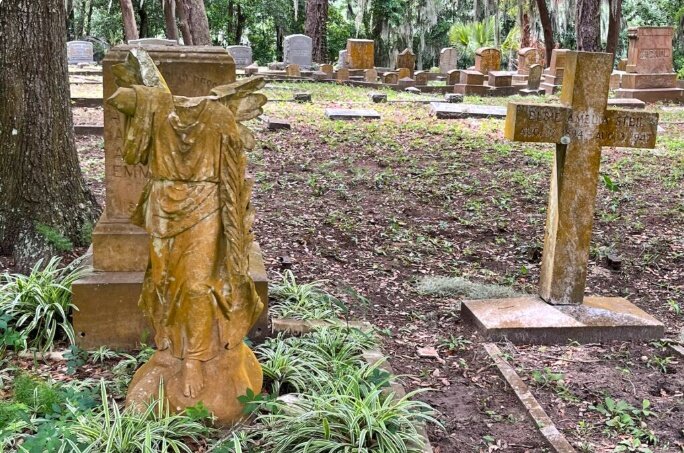
The campaign for National Register recognition began in 2022 when the Amelia Island Fernandina Restoration Foundation adopted Bosque Bello as a priority preservation project.
In 2023, the foundation partnered with the city to pursue grant funding through the Florida Department of State's Division of Historical Resources.
The foundation coordinated the multiyear nomination process, while consulting firm Terracon conducted historical research and prepared the documentation required for federal consideration.
The Florida State Historic Preservation Office, local historians, preservation organizations and community members also contributed to the effort.
The National Park Service officially added Bosque Bello to the National Register on Nov. 3, with the listing appearing in the agency's Nov. 6 publication of newly recognized historic properties.
The designation follows preservation work that began long before the latest nomination.
In 2012, Fernandina Beach city staff assembled residents and stakeholders to begin developing a cemetery master plan. Public surveys and a workshop followed, and the city completed the plan in 2015.
That document examined cemetery maintenance, historic monument preservation, landscaping, public access and the challenges of caring for an aging burial ground.
It also documented the cemetery's historical development and recommended protecting its distinctive character.
The National Register of Historic Places is the federal government's official list of properties considered significant in American history, architecture, archaeology, engineering or culture.
Listing does not automatically provide money for restoration or prevent the city from maintaining and operating the cemetery. Federal projects or federally funded activities affecting a listed property can be subject to historic preservation review.
The designation can strengthen applications for certain historic preservation grants and provide a formal historical record to guide future work.
The city said efforts to preserve and share Bosque Bello's history will continue, including support for a proposed multimedia walking tour that would allow residents and visitors to learn about the people buried there.
The city credited the Amelia Island Fernandina Restoration Foundation, Terracon, the Florida Department of State, city employees, local historians and community volunteers for completing the nomination.


Comments
No comments on this item Please log in to comment by clicking here