 >
Airport noise, safety fears dominate Fernandina Beach Master Plan comments
City Commission Airport Workshop is this Wednesday at 4:30 p.m.

FERNANDINA BEACH — A Crane Island couple says they have counted as many as 30 repetitive takeoffs and landings by the same training aircraft near their home, one of dozens of complaints about flight school noise submitted during the city's public open house on the Fernandina Beach Municipal Airport Master Plan.
Warren and Doreen Byrd, who live on Crane Island next to the airport, said they expected aircraft noise when they moved there about 18 months ago. Warren Byrd is a private pilot. But the couple said the volume of traffic has increased significantly.
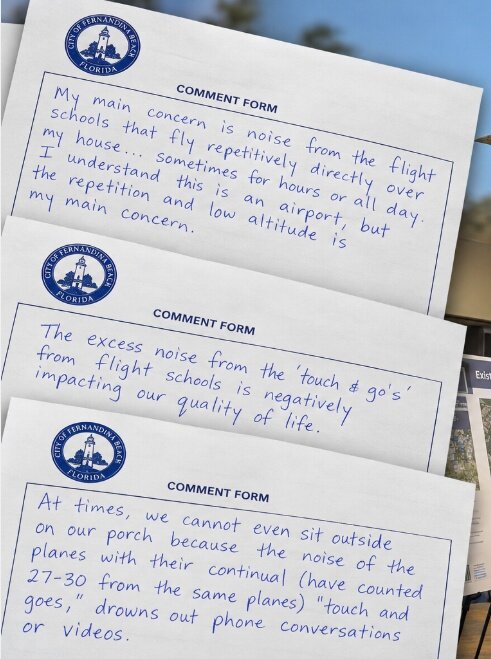
"At times, we cannot even sit outside on our porch because the noise of the planes with their continual (have counted 27-30 from the same planes) 'touch and goes,' drowns out phone conversations or videos," they wrote in an email to airport officials following the Oct. 24 open house.
Their complaint was among a collection of 45 pages of written public comments submitted during the city-sponsored meeting and obtained by The Observer. The submissions focused heavily on repetitive flight school operations, low-flying aircraft and the effects of airport activity on surrounding neighborhoods.
Residents also proposed restrictions on flight training, changes in aircraft operating hours, landing fees and stronger enforcement of the airport's voluntary noise abatement guidelines. Others questioned future airport expansion and whether nearby homeowners have sufficient representation in airport planning.
The comments provide a record of residents' concerns, although they do not establish how frequently aircraft are conducting training operations or whether individual flights violate aviation regulations.
Randy Hatton, who lives on First Avenue, said the problem is not simply that aircraft fly over his property but that training planes repeatedly circle at low altitude.
"My main concern is noise from the flight schools that fly repetitively directly over my house ... sometimes for hours on all day," Hatton wrote. "I understand this is an airport, but the repetition and low altitude is my main concern."
Bob and Denean Bradecamp submitted a similar complaint.
"The excess noise from the 'touch & go's' from flight schools is negatively impacting our quality of life," they wrote.
Elizabeth Rawson said training activity has made it difficult to enjoy her outdoor property after 24 years in her home.
"The Flying School has made our life here after 24 years miserable to use our outdoor area," she wrote.
Cheryl Witt described repeated aircraft noise during early morning dog walks, saying she sometimes cannot carry on a conversation because training planes continue passing overhead.
 Witt also opposed runway expansion to accommodate larger jets.
Several residents offered detailed recommendations for reducing repetitive training flights.
Shari Roan of Parkway North submitted a proposal to strengthen the airport's voluntary noise abatement procedures, including:
-
Limiting flight schools to one training visit per day, with no more than five touch-and-go or approach-and-go operations per visit.
-
Restricting repetitive training to 9 a.m. through 5 p.m. and prohibiting it on weekends and holidays.
-
Limiting touch-and-go training to three general aviation aircraft at a time.
-
Maintaining an altitude above 1,000 feet during certain takeoff and landing operations.
-
Requiring airport staff to contact flight schools when complaints are received and respond to residents within five business days.
Roan also proposed changes in aircraft traffic patterns to reduce flights over residential neighborhoods.
The recommendations are proposals, not existing airport regulations. Their implementation would depend on the city's authority and applicable FAA requirements.
Other residents proposed charging flight schools for repetitive operations.
Shelley Snell and Robert Kossman suggested a daily landing fee or seasonal pass, comparing the concept to fees charged to boaters using marina docks.
Jill Freedman questioned why outside flight schools should be able to conduct repeated training flights without producing what she believed was corresponding airport revenue.
The submissions did not include financial records establishing whether flight school operations generate airport revenue through fuel purchases, fees or other activities.
Aircraft noise from Cessna 172 and 182 planes was not the only complaint.
Alan Jones, a Canopy Drive resident, described excessive aircraft noise during early morning and evening hours. He also reported observing what he considered unusual aircraft maneuvers near his home.
"This is clearly a safety concern," he wrote.
Roy and Priscilla Leek said they were exhausted by the number and frequency of touch-and-go flights over their house.
They said some aircraft appeared close enough that they could see the pilots, calling the situation both a noise problem and a safety concern.
Douglas August requested noise and environmental impact studies as part of the airport planning process. He expressed concern about runway 4-22 and the possibility of accommodating larger aircraft.
August also suggested evaluating flight patterns over residential areas, especially those used by training aircraft.
John Meyer asked whether protected migratory birds had been identified as an environmental concern. He cited bald eagles, wood storks and ospreys observed near his home.
Other commenters questioned whether future airport development could affect nearby recreational facilities.
Elton Twill specifically raised concerns about soccer fields on Bailey Road, arguing that the city should consider the value of existing recreational space when evaluating airport expansion.
Suzanne Ray, who lives in the Parkway North neighborhood, questioned whether the airport should pursue additional aviation development rather than other potential uses of airport property.
 She said her family was concerned about noise pollution, safety and environmental effects.
Several written submissions questioned how surrounding neighborhoods are represented in airport planning.
Roan requested that at least one non-aviation city resident be appointed to the airport's Technical Advisory Committee or that the city establish a community advisory committee or community noise roundtable.
Her submission cited FAA airport planning guidance encouraging community involvement and said residents had previously requested representation on the Technical Advisory Committee but were turned down.
Roan also questioned why non-aviation residents had been excluded from the committee when, according to her submission, other members without aviation backgrounds had served on it.
Carolyn Lalli called for greater communication with residents about the airport's obligations to the FAA and how those requirements affect local decisions.
John Gill questioned whether the planning process was giving adequate consideration to residents who do not use the airport.
"Is this all about A/C needs with NO consideration for the 95% of people who live here and never use the airport," Gill wrote.
The 95% figure was Gill's assertion, not a documented finding in the materials.
Not every submission criticized airport operations or the planning process.
P. William Smith, who owns three homes on South Fletcher Avenue between runways 6 and 13, said aircraft noise does not bother him.
"We own three homes on South Fletcher between runways 6 and 13 and the airplane noise does not bother us," Smith wrote in an email forwarded to city officials.
Smith said he would nevertheless support restrictions on training flights by nonresident flight schools if such restrictions were feasible and permitted by the FAA.
Another commenter thanked airport officials for addressing residents' concerns and correcting what the writer considered misinformation about airport data.
Jim Trappe praised the presentations.
"Nice explanations. Plans look good & reasonable," he wrote.
The comment forms were voluntary submissions and do not constitute a representative survey of Fernandina Beach residents or airport users.
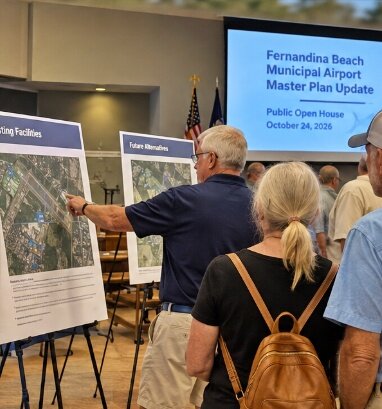
The Oct. 24 open house was part of the city's ongoing update to the Fernandina Beach Municipal Airport Master Plan, which examines existing airport facilities, future aviation demand and potential development alternatives.
Airport officials explained during the open house that the master plan will identify existing and projected aircraft noise exposure, but recommendations for specific noise reduction measures would require a separate study.
That distinction leaves many of the residents' requests outside the immediate scope of the master plan, particularly proposals to restrict flight training operations, impose time limits or change aircraft flight patterns.
The city has scheduled a separate City Commission airport noise workshop for Nov. 4.


Comments
No comments on this item Please log in to comment by clicking here